 |
||
|
||
|
|
|||||
|---|---|---|---|---|---|---|
 |
| Corporate influence on food and health policy |
|
Did you know big food giants like Nestle, Mars and Coca Cola put millions of dollars a year into sponsoring health and food research? While this might sound like an act of benevolence, the money spent gives them enormous power to influence research findings, whether consciously or not. The scope for influence is even larger in developing nations, where processed food companies are often a major source of funding for universities Research has shown that industry sponsored studies are more likely to show favourable results. Take chocolate as an example - studies have long been finding supposed health benefits, thanks in part to millions of dollars of funding from Mars, Nestle, Hershey's and others. The research often shows amazing claims - chocolate fighting arthritis, dementia, heart disease and more! But critics have pointed out many design flaws and biases in the research. Funding isn't the only method used to wield influence. A 2020 study analysed over 4000 tweets by food companies in Australia, revealing significant ways companies use social media to sway public opinion and influence policy too. What you can do:
|
 |
| Growing veg to feel better, eat better and save the planet |
|
According to research conducted by Roy Morgan, 2.5 million Australians now have diets of which the food is all, or almost all, vegetarian or vegan. – that's an amazing 12.1% of adults in Australia! In the last decade people following a plant-based diet has increased by about 50%. Additionally, from the humble backyard vegetable patch to herb gardens on the kitchen windowsill – 9 million Australians are now growing their own food, according to the new Grow Your Own report by The Australia Institute, in partnership with Grow It Local.
More than two thirds (69%) of those who grow their own food say they do it to access healthy food, while 60% do it to save money. Growing your own helps cut down waste during the ongoing cost-of-living crisis, with almost two thirds of growers composting or worm farming, preventing mountains of food waste from ending up in landfill. Find out more about growing your own veg at Grow It Local. |
 |
| Source Spotlight: JUST Capital |
|
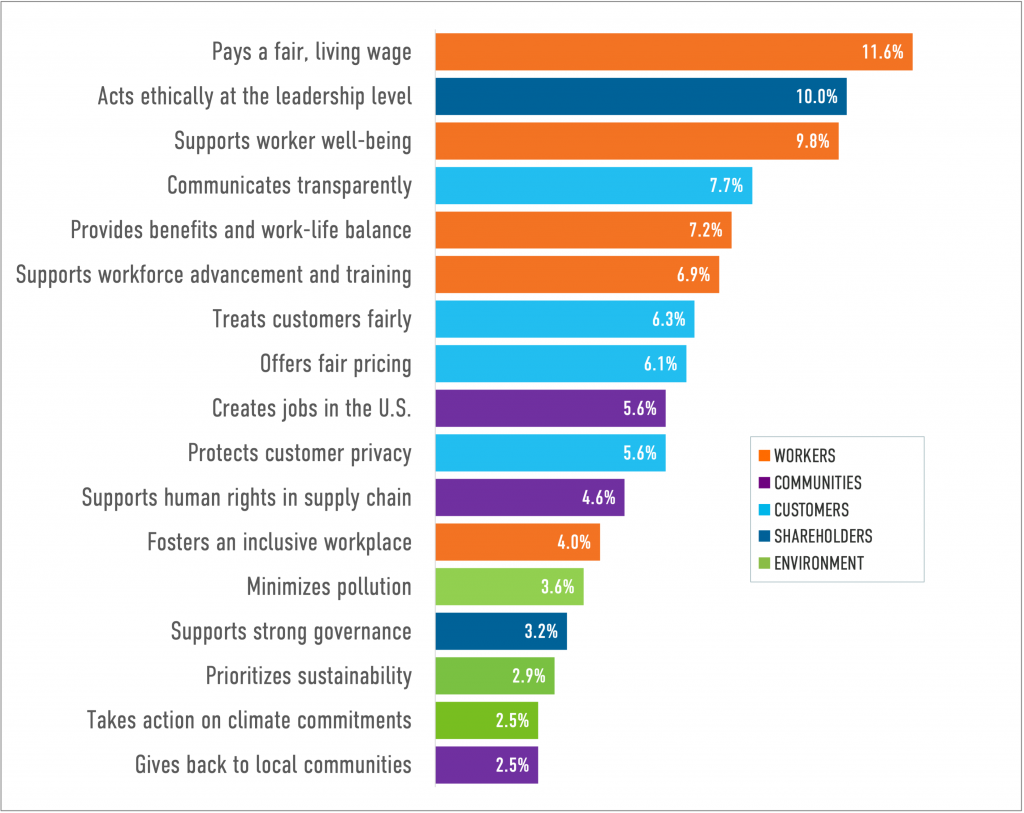
JUST Capital polls Americans every year to identify the issues that matter most in defining just business behaviour. For their 2025 rankings the public identified 17 issues, which are organised under the headings Workers, Communities, Customers, Shareholders and Environment. JUST Capital then define metrics that map to those issues and track and analyse the largest, publicly traded U.S. companies. This analysis powers their rankings, where they ranked 940 companies. The image below shows what JUST Capital polling has identified as the "Priorities of the Public", and therefore how they have split the weightings in their overall assessment. There are limitations to their methodology, however - for instance, despite living wages being rated most important by the public year after year, JUST Capital only considers wages paid to US workers under this score, not workers in other countries (which make up a huge proportion of the supply chain in some industries). |
 |
|
Check out this month's free assessment search to see and compare over 100 companies in our database with JUST Capital ratings. |
|
|
||||||
 |

